
I’ve dabbled in Tekken games on and off since the first demo disc came out for the original PlayStation. Often fancying myself as someone who could reallyg et to grips with it, and then never actually getting anywhere. But recently, I’ve wanted to give it another go, and picked-up Tekken 7 on Steam for a fiver.
Naturally, starting at 7 and only really having played a few hours total of the rest of the series. I thought I would like to perhaps understand the Tekken story better.
Well…..then I started to read, and learn, and honestly. I’m still not sure I understand any of it. But I am, at least, better informed. The history of the Mishima Family Feud is insane (in the best way). Tekken is still a standard bearer for the genre. I just had no clue it was quite so intense from a story perspective.
Here’s a nice breakdown of the story in chronological order, game to game. Good luck understanding it!

The Prequel: Death by Degrees
While released later in the series, this action-adventure spin-off serves as a prequel to the first Tekken game. It focuses entirely on the assassin Nina Williams. The story reveals the origins of the bitter rivalry between Nina and her sister, Anna Williams.
It details their childhood training under their father, Richard Williams. His eventual death, for which both sisters blame on the other. Nina is tasked by the CIA to infiltrate a criminal organization known as Kometa on a luxury cruise ship.
The game establishes Nina’s cold, professional personality. Explaining why she and Anna have spent their entire adult lives trying to kill one another. Adding emotional weight to their fights in the main series.
Tekken 1: The First Act of Vengeance
The main saga begins twenty-one years after the tyrannical head of the Mishima Zaibatsu, Heihachi Mishima, cast his five-year-old son, Kazuya Mishima, off a cliff.
Kazuya, surviving the fall by making a pact with the Devil to activate the Devil Gene, vows revenge. Heihachi, unaware of his son’s survival and demonic power, announces the first King of Iron Fist Tournament to test his power and find a worthy successor.
Kazuya enters and cuts a path of destruction straight to the final round, where he defeats his father.
Fulfilling his long-held desire for vengeance, Kazuya carries Heihachi’s unconscious body to the same cliff and throws him over. Then he claims control of the global Zaibatsu corporation.

Tekken 2: The Return and the Sacrifice
Two years after taking over the Zaibatsu, Kazuya has transformed it into an even more ruthless organization. Even funding black-market genetics and global terrorism. He announces the second King of Iron Fist Tournament to crush the remaining resistance and lure out any challengers.
Unbeknownst to Kazuya, Heihachi survived the fall in the first tournament and spent two years training intensely, preparing his return.
During this period, Kazuya encounters Jun Kazama, a spiritual martial artist and wildlife officer, who is drawn to the conflict between Kazuya’s good and evil sides. Their brief, intense encounter results in Jun becoming pregnant with their son, Jin Kazama.
The tournament culminates in Heihachi defeating Kazuya. This time, Heihachi takes Kazuya’s body to an active volcano and drops him into the magma, ensuring that his reign is ended. Then he once again seizes control of the Zaibatsu.
Tekken 3: Jin’s Debut and Heihachi’s Ultimate Betrayal
Fifteen years pass. Jun raises Jin in the secluded mountains, protecting him from his father’s fate and the Devil Gene. However, an ancient fighting god known as Ogre awakens and attacks them, killing Jun (or causing her to disappear).
Jin, now an orphaned martial artist, seeks out his only living relative, Heihachi, for training and vengeance. Heihachi, seeing an opportunity, trains Jin in the Mishima fighting style while secretly planning to use him as bait to draw out Ogre, whose power he wants for himself.
He announces the third tournament, which ends when Jin successfully defeats Ogre (and its final form, True Ogre).
Immediately following the victory, Heihachi and his Tekken Force betray Jin, shooting him in the head. This betrayal triggers the dormant Devil Gene in Jin, who revives, transforms, and escapes the compound. Leaving Heihachi to face the catastrophic repercussions of his actions.
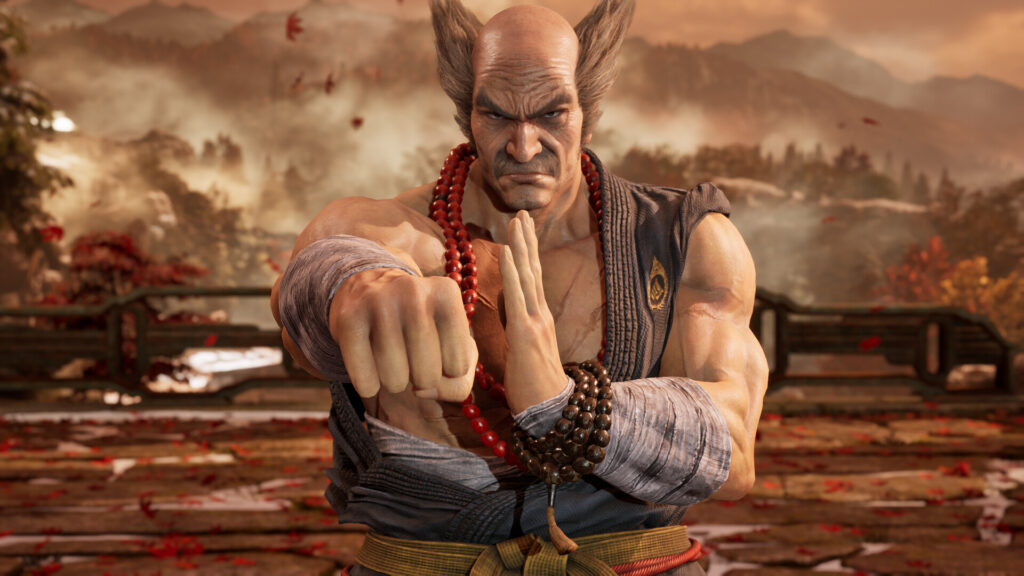
Interlude: Tekken Tag Tournament
Released between the third and fourth tournaments, this title serves as a non-canonical “dream match” festival. Fighters who were previously killed or missing (such as Jun Kazama and Baek Doo San) return to fight alongside the current generation.
The primary narrative focus is a mysterious final boss known only as Unknown. A woman possessed by a demonic wolf spirit.
In the game’s ending, it is implied that Unknown is actually a tragic, corrupted version of Jun Kazama, Jin’s mother.
The game famously ends with a cinematic of Jin Kazama pointing a gun at his father, Kazuya, foreshadowing the violent confrontation that would eventually happen in the next canonical installment.
Tekken 4: The Hunt for the Devil Gene
Heihachi, determined to achieve immortality by fusing Ogre’s DNA with his own, needs the Devil Gene to complete the process.
He learns that Kazuya’s body, which G Corporation secretly retrieved from the volcano, has been resurrected, and the Devil Gene within him is now whole.
Heihachi sets up the fourth tournament specifically to lure both Kazuya and Jin into a trap. Jin, still struggling with the Devil Gene’s influence, enters, while Kazuya enters to defeat his father and reclaim his power.
Heihachi’s plan ultimately succeeds in capturing both Kazuya and Jin, holding them captive at the Honmaru ancestral compound.
After a confrontation between Kazuya and Heihachi, the two face Jin. In a climactic showdown, Jin defeats both his father and grandfather. Yet, seeing a vision of his mother, Jun, Jin decides to spare their lives before flying away, leaving the Mishima family rivalry unresolved.

Tekken 5: The Ancestral Threat
Moments after Jin’s departure from Honmaru, a squadron of Jack-4 robots, sent by G Corporation, attacks the compound. Kazuya seizes the opportunity to escape, throwing Heihachi into the explosion and leaving him to die.
The destruction shatters a decades-old seal beneath the compound, releasing Jinpachi Mishima, Heihachi’s long-imprisoned father.
Jinpachi, now possessed by a vengeful entity, takes over the Zaibatsu and announces the fifth tournament.
Jin enters the tournament, driven by the need to confront the root of his bloodline’s evil. He defeats his great-grandfather, ending the ancient threat, and in doing so, legally takes control of the Mishima Zaibatsu.
Tekken 6: The World War of the Heir
Now the leader of the Zaibatsu, Jin Kazama uses his corporate and military power to plunge the world into a massive, catastrophic war. Declaring independence and seizing control of nations.
Kazuya, through G Corporation, positions himself as the only global power capable of opposing the Zaibatsu, maintaining a shadow war with his son.
Jin’s true purpose, is revealed to be a sacrificial act. He intends to generate enough negative energy through the global conflict to awaken Azazel, the ultimate source of the Devil Gene. Jin believes that only by destroying Azazel with his own life force can he finally eradicate the Devil Gene from his bloodline and the world.
He defeats Azazel in an ancient temple, disappearing in the resulting blast and leaving the world in turmoil.

Interlude: Tekken Tag Tournament 2 & Tekken Revolution
Following the global chaos of the sixth tournament, the series paused for another dream match in Tekken Tag Tournament 2. While non-canonical, the story deepens the tragedy of the Mishima family by exploring the “Unknown” entity further.
It is confirmed that this boss is indeed Jun Kazama. He has been corrupted by a malevolent force in the years since her disappearance. Many of the character endings focus on the heartbreaking relationship between Jin and his mother, showing a peaceful alternative timeline where her love saves him.
Following this, Tekken Revolution was released as a free-to-play title. It stripped away the story to focus purely on an arcade ladder, but it did introduce Eliza, a vampire asleep for centuries under the care of Lili’s ancestors, who would later join the main canon in Tekken 7.
Tekken 7: The Final Duel of Father and Son
With Jin missing, Heihachi – who had survived the explosion in Tekken 5 – reclaims the Zaibatsu and seeks to expose Kazuya’s Devil form to the world, framing him as the source of the global conflict.
The game delves into the backstory of the feud, revealing that Heihachi’s wife, Kazumi Mishima, was the original bearer of the Devil Gene. Heihachi was forced to kill her decades ago to save the world, which is why he threw Kazuya off the cliff.
The two old rivals, Heihachi and Kazuya, finally meet for what they both know is their final fight in the crater of a volcano.
After an earth-shattering battle, Kazuya defeats Heihachi and drops his body into the active magma, finally ending the life of the originator of the Mishima blood feud.

Tekken 8: The End of the Cycle
Six months after Heihachi’s death, Kazuya begins his final, brutal world war, aiming for total global domination.
Jin Kazama, having awakened and recovered, joins forces with allies like Lars Alexandersson and the spiritual guidance of his supposedly deceased mother, Jun Kazama, to stop his father.
Jin learns to embrace the power of the Devil Gene not as a curse but as a tool for justice, transforming into a form that balances his dark and light power.
The conflict culminates in an epic final battle that sees Jin defeat Kazuya.
In the aftermath, Jin is able to suppress the Devil Gene in both himself and his father, bringing the horrific, generations-long curse to an end.
However, a post-credits scene introduces Reina, Heihachi’s secret daughter, who exhibits her own awakened Devil Gene, hinting that the Mishima cycle of dark power may not be over yet.
To be continued….
With the post-credits scene of Tekken 8, we just know that the cycle is far from over. May the tradition of throwing people off cliffs and into volcanos continue forever.
Tekken is one of the best fighting series that there is. Mechanically solid and satisfying to those fighting game conesseuirs and being a regular at massive tournaments. The impact of the series is significant and will likely last for many decades to come.
Will we understand the story of what’s going on? Unlikely. Do we need to? Not really. If you enjoy the games from a technical perspective and love getting to grips with characters old and new. The graphical updates, the work to make them more broadly accessible, and the want to keep fans happy, mean that you’re always getting more of the good stuff.
The story is just a means to deliver some narrative purpose for the series, but the gameplay itself is more than enough to justify why it exists.
I’ll likely never be good at Tekken, and my current foray into Tekken 7 will probably get cut short when I get frustrated at my lack of ability. I will always keep an eye on the series, though. Because it’s fascinating.